Opening reception: Friday, 22 August 2025, 6 to 8 p.m.
A Closed Open Door
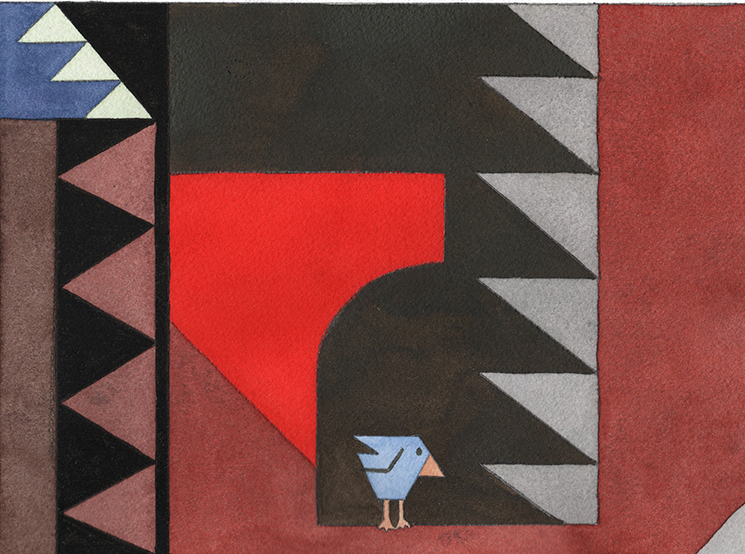
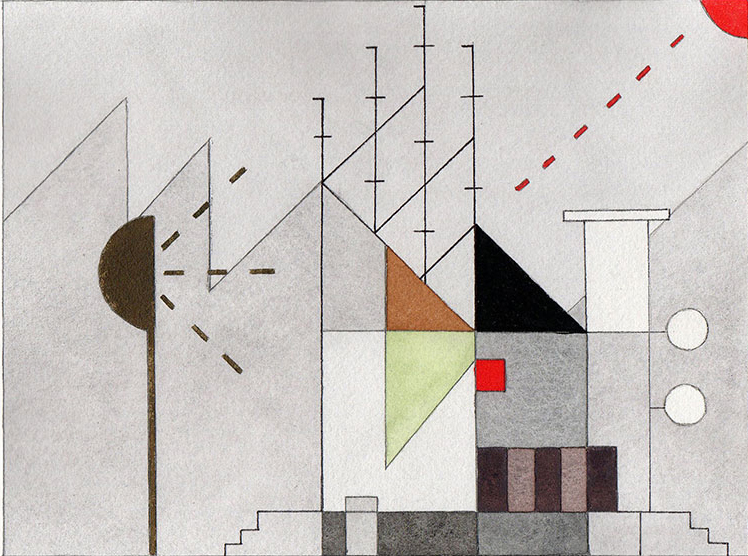
Allegories can make abstract ideas tangible by expressing them through figures and symbols. Patricia Bucher, however, moves precisely at this threshold – but in a different direction. For several years, the artist has been collecting all kinds of signs – hieroglyphs, ornaments, pictograms, traffic signs, and graphic codes from comics – fragments of a visual language. She draws on this extensive repertoire to create works that do not make the abstract more concrete, but rather render the concrete more abstract.
One thing, however, does seem to become more tangible: the absurdity of ever considering concrete ideas as truly fixed. For every sign harbours ambiguity – or at least the potential for ambivalence – especially when it appears alongside others. Bucher’s practice can be understood in the sense proposed by theorist and psychoanalyst Julia Kristeva, who described signs as dynamic: never static vessels of meaning, but processual sites of ambiguity – particularly where they encounter each other in spatial constellations.
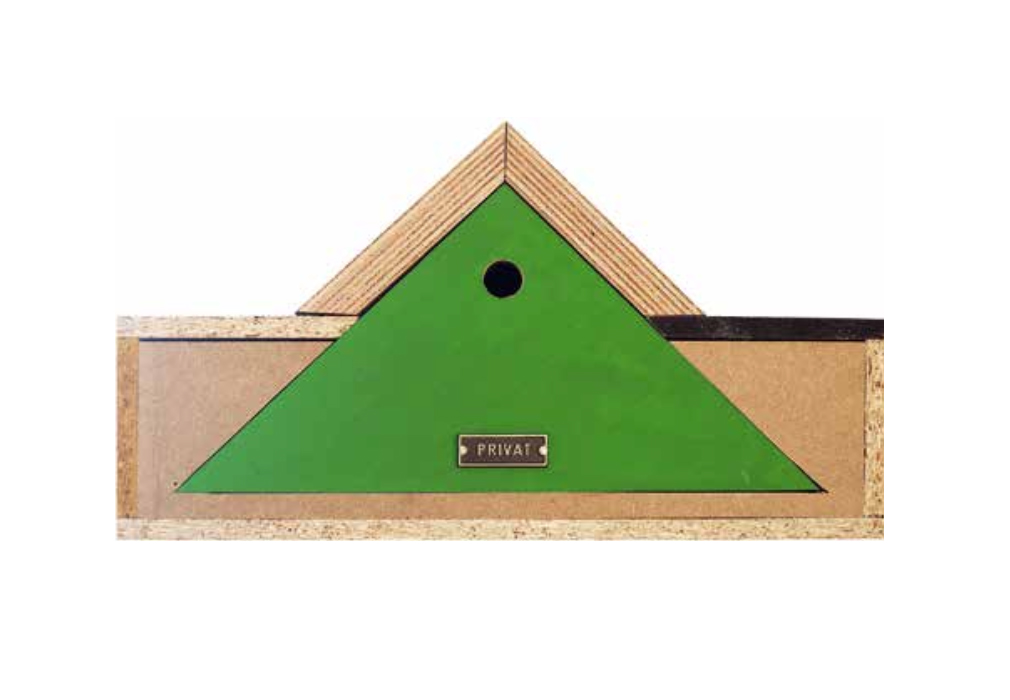
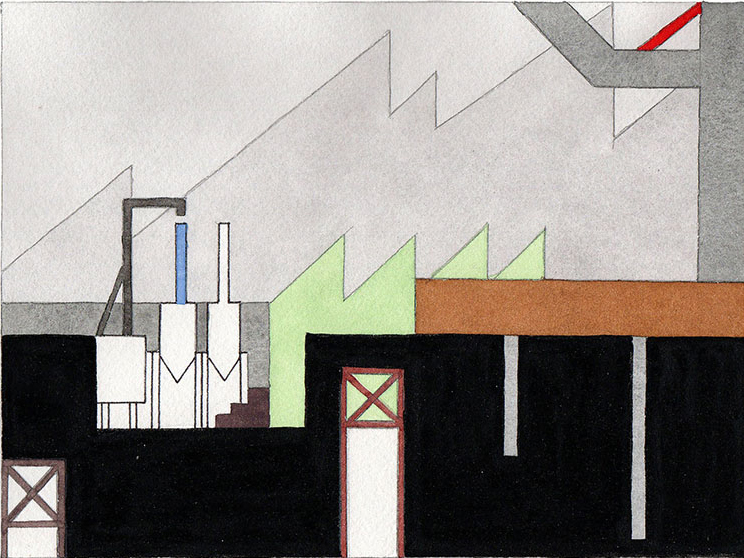
Bucher’s entire body of work can be described as such spatial constellations – even those that are two-dimensional. It is precisely the absence of the third dimension that makes her drawings and prints so thought-provoking: they prompt us to imagine how these flat elements might relate to one another if placed in space. Several motifs recur in new prints and in a new wooden frieze – including garden fences, solar panels, and chimneys. The latter are especially prominent and already familiar from earlier works. Jagged clouds of steam or smoke rise from them, sometimes blending with architectural forms. Comparable to different states of aggregation, the meanings of these shapes are not fixed. Dotted lines suggest rays – or perhaps sound waves. What they all share is a range of intensities, with fluid transitions between them.
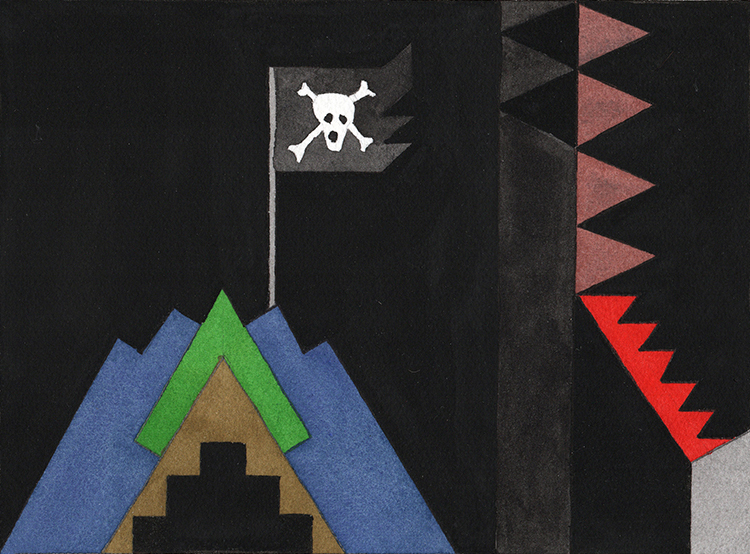
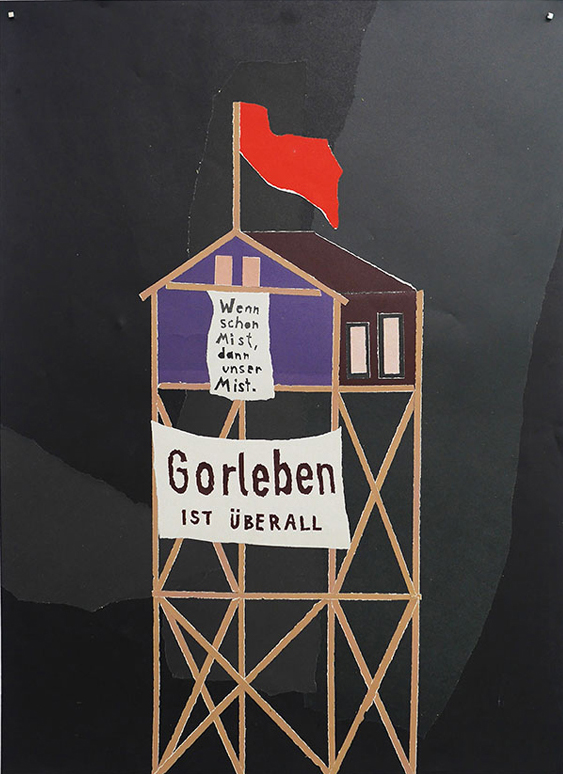
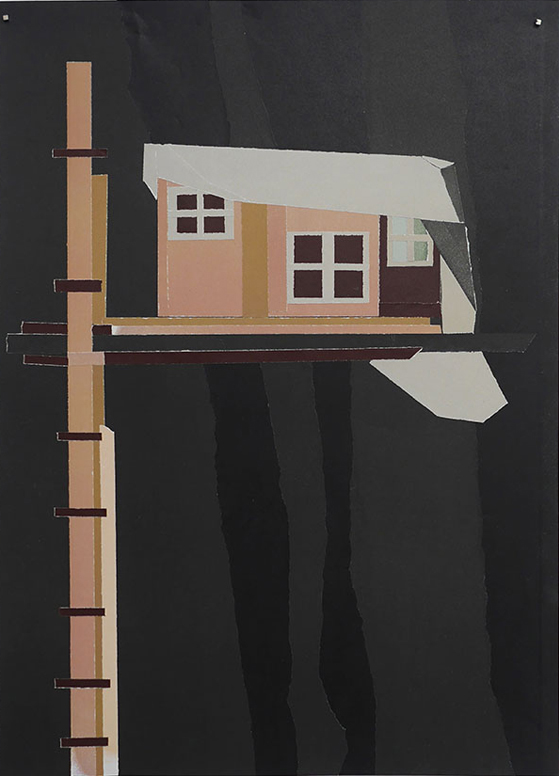
The constructed nature of language is explored in a series of collages made from torn paper. Against a nocturnal backdrop, structures emerge that allude to squatter settlements. Here, the artist references resistance movements against lignite mining in Lützerath and Hambach Forest in Germany. Barricades were built to halt destruction – by creating disruption. In some cases, they intertwine with the remaining forest in the form of tree houses. Made of lightweight materials, quickly assembled yet stubbornly obstructive, these become operative signs. The collages reveal that these structures also possess a kind of inherent poetry.
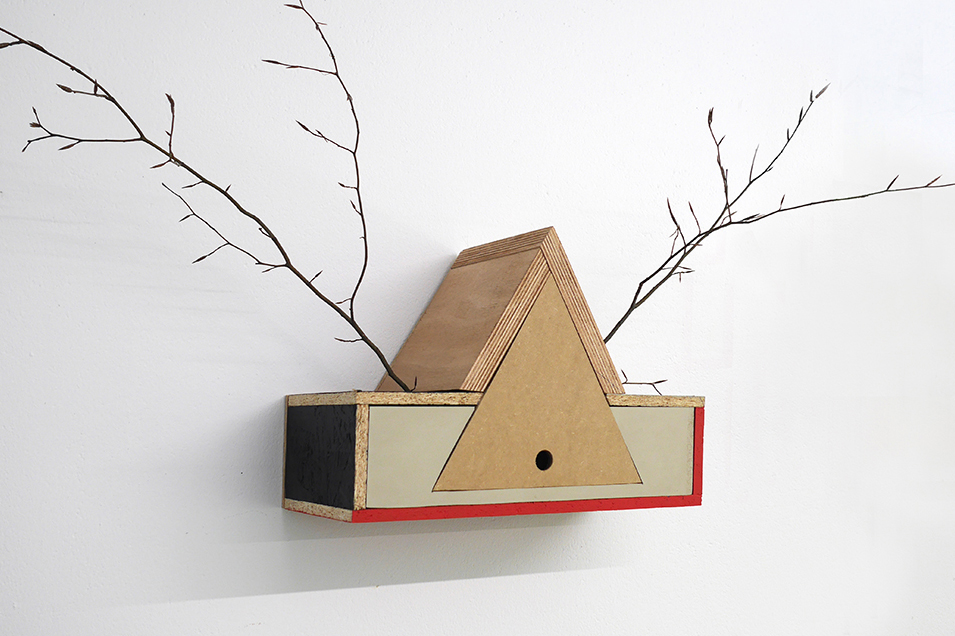
In the spirit of architect John Hejduk, Bucher’s works resist purely instrumental logic and modernist functional rationalism: form cannot simply follow function like a pacemaker. Take, for example, the sculpture made from a hamster wheel and a clock face. Beyond the symbolic reading of a high-speed society, its impact lies above all in its combination: dysfunctional, yet precise. Elementary, but not universal.
If language shapes our thinking, Patricia Bucher shapes our thinking about language. Her works open up transitions and unexpected spaces. They place us directly at the threshold of a closed open door.
Irène Unholz
Irène Unholz studied art history, psychology, and communication science in Fribourg and Berlin. She is currently a doctoral candidate at the University of Fribourg and works as a cultural journalist.
More about Marianne Halter & Mario Marchisella
Artist Talks:
Saturday, August 30, 2025, 2 p.m.
Thursday, September 11, 2025, 7 p.m.
Finissage:
Saturday, September 13, 2025, 2–4 p.m.

Catalog